Moodboard




Sprout is a botanical almanac rebuilt as an instrument of foresight: memory made visible as a running system. Monospace telemetry on an exposed grid, two inks only — the quiet magic of knowing tomorrow before the leaf does, rendered with the calm of a well-kept log.
This world is NOT…
- No hand-painted monstera leaves, terracotta gradients, or 'plant parent' cooing in any copy
- No red-alert triage states — the system speaks before crisis, so the palette never panics
- No badges, streaks, or social feeds; the reward is a plant that's still alive, logged in one quiet line
- Leaf-green and terracotta palettes, hand-painted watercolor monstera leaves, soft rounded friendly type, and taglines about 'your plant-parenthood journey'. The 'design-forward' plant apps go the other way: stark near-black-and-white minimalism with a single signal accent.
- Not a botany encyclopedia, not a plant-parent social network, not a triage tool for something already half-dead.
Color
Typography
Concept
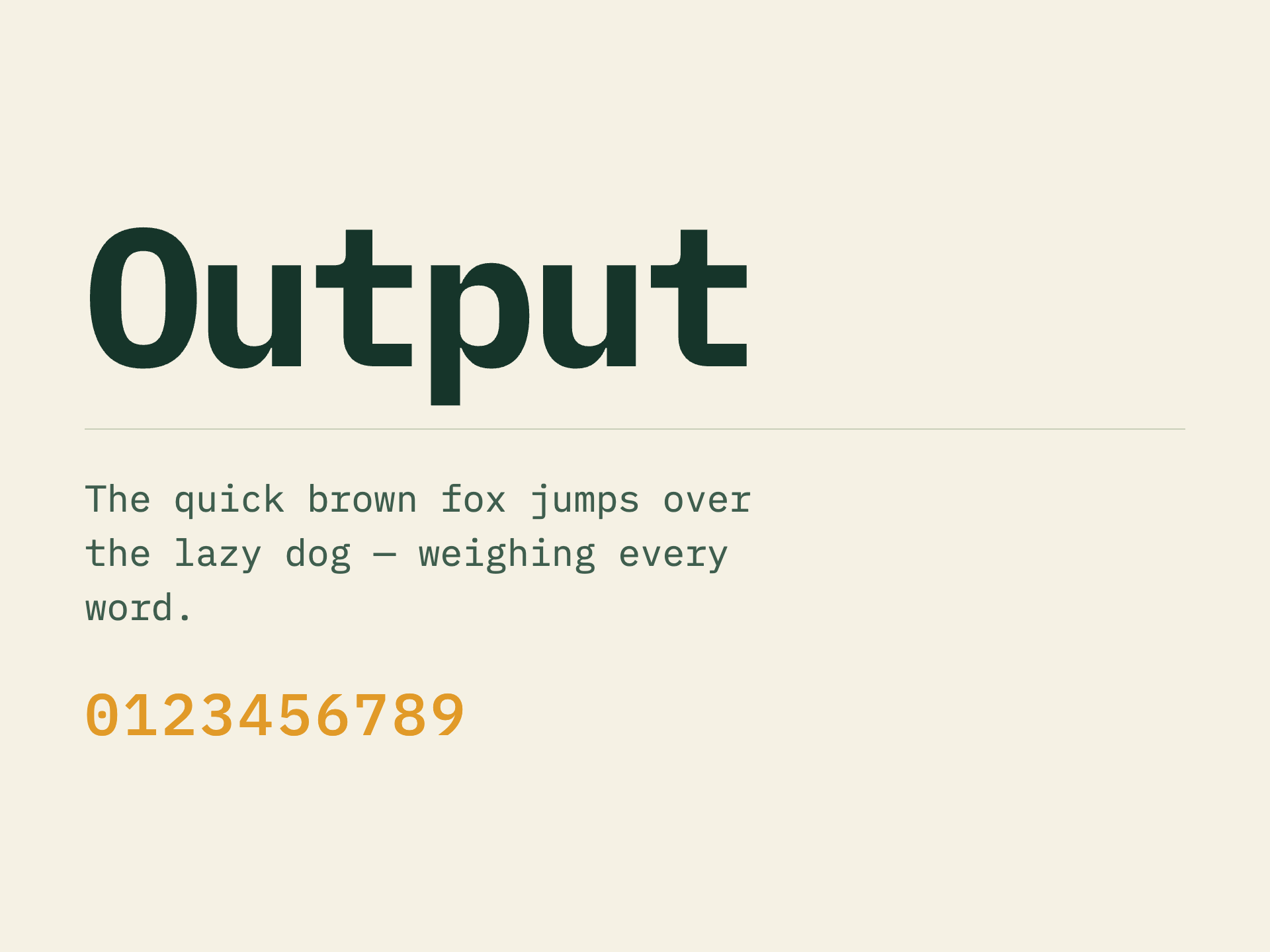
The coordinate places Sprout at magician × monospace × modular-exposed × duotone, and the vision resolves that into a single thesis: an almanac rebuilt as an instrument of foresight. Every color token descends from the two-ink mandate. The paper is a genuinely warm bone (#F5F1E4 through #FFFDF4 across elevation), the primary ink is deep chlorophyll (#16352A) with muted and subtle steps mixed toward the paper rather than toward gray — so even the hairline borders (#C9CFB9) read as ruled ink on stock, keeping the exposed grid visible as a material fact. The second ink, prediction amber (#E19A28), exists for exactly one job: the lit tomorrow-cell and its adjacent actions, per the composition plan's instruction that it appears 'only here-adjacent.' The anti-move against red-alert triage shaped the semantic tokens directly — danger is a muted rust (#A65A2A) that stays inside the almanac's warm register, because a system that warns the day before never needs to shout. Typography and form follow the same chain. Monospace typeVoice plus the Swiss-timetable and seismograph references demanded a mono that can hold both telemetry and headline duty; IBM Plex Mono serves as both display (500/700) and body (400/500), so the entire surface speaks in one logged voice and the plant glyphs, marks, and type genuinely share a grid module — the third signature move made literal. Geometric-sharp formLanguage set radii at 1–3px, a print-registration softening rather than friendliness, which is also the explicit rebuke to the category's soft rounded type. Subtle-depth finish appears as chlorophyll-tinted shadows in two low-contrast steps, lifting instrument panels barely off the paper; subtle motionCharacter constrains everything to 150–250ms eased fills with a barely-sprung curve — the DayGrid cell lights, it never flashes. The composition plan drove the component set and voice architecture. Because s1's hero IS the day-grid (focalWeight 5, modular-panels, data-led), the DayGrid is elevated to a first-class component with the one-lit-cell rule encoded in its usage notes; s3 and s6 (the next-heaviest sections) reuse it as tile and as empty-instrument invitation, which is why the accent token carries strict scarcity rules on Button as well. The voice tokens execute s2's guilt-free reframe ('you cared, you forgot') and s4/s5's tabular restraint: timetable phrasing, dated log lines, no exclamation marks, and the anti-moves enforced as hard don'ts — no plant-parent cooing, no panic, no streaks or badges. The reward is stated the way the vision demands it be earned: a plant that's still alive, logged in one quiet line.
Voice
Personality
Tone rules
- Speak like a well-kept log: dated, factual, complete sentences kept short — the calm of an instrument that watches continuously and speaks rarely.
- Name the failure mode without guilt: the user cared, the user forgot. Frame forgetting as a schedule problem the system now owns, never as a character flaw.
- Reserve emphasis for prediction. The only moments that earn heightened language or the second ink are 'tomorrow' statements — everything else stays in the primary register.
Do
- Use timetable phrasing: 'Water: every 6 days, next on Thursday.' Concrete cadences, real dates, no vagueness.
- Write in the almanac voice — 'Day 14. Soil moisture holding. No action needed.' Let logged lines carry the emotional weight.
- State the reward plainly and once: a plant that's still alive, recorded in one quiet line.
Don't
- Never coo. No 'plant parent', 'plant babies', 'green thumb journey', or any watercolor-adjacent sentimentality.
- Never panic. No alarm language, no red-alert framing, no 'URGENT' — the system speaks before crisis by definition.
- Never gamify. No streaks, badges, points, confetti, or social proof. No exclamation marks anywhere.
Example copy
Forgetting kills plants. This log doesn't forget.
Tomorrow: your calathea's soil crosses its dry threshold. Watering moved to tonight, 8pm — the hour you're actually home.
Start the log. Your first tomorrow is already scheduled.
Powered by Variel
Make your own brand
Generate a living design system — tokens, voice, components, and moodboard — in minutes. Share it publicly. Enforce it automatically on every pull request.
Generate your brand