Moodboard

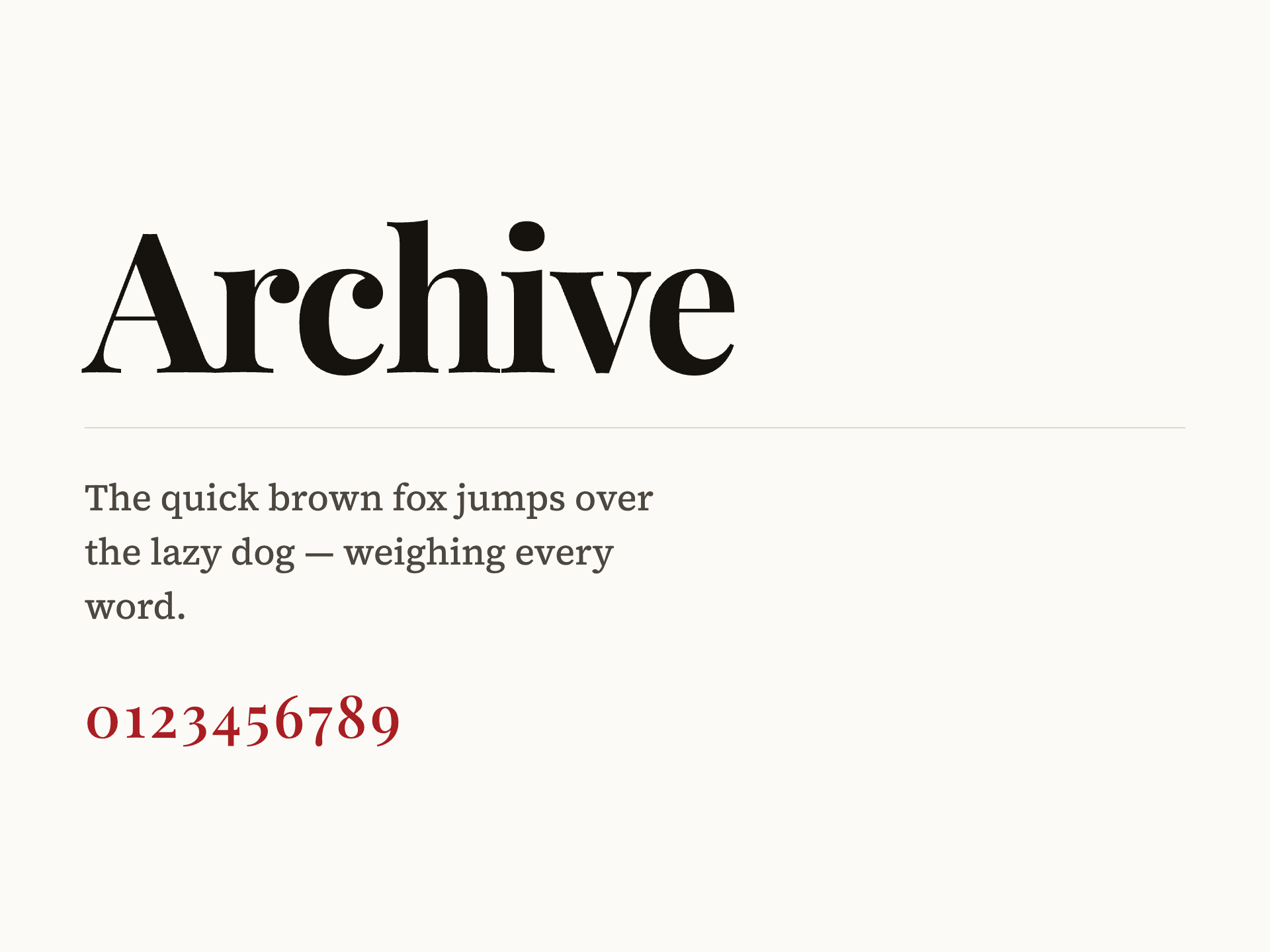



Trust is written down like law: the changelog as an official record, set in serif on a strict grid with the calm of a government gazette. Near-black ink on paper-white, generous margins, and one seal-red accent that marks each entry as ratified — shipped, witnessed, on record.
This world is NOT…
- No terminal-window mockups, no neon-green monospace glow, no blinking cursor theater
- No rounded cards, drop shadows, or pastel friendliness — nothing that apologizes for being a document
- Never gradient, never glassmorphism — the record is flat ink; authority does not shimmer
- Two default lanes: pure-black dark mode with neon-green monospace, terminal-window mockups, and glowing cursor blinks — or, when they soften it, the friendly-SaaS default of rounded humanist sans (Nunito, Quicksand), soft cards with subtle drop shadows, and gentle desaturated pastels. Both read as template output.
- Not a docs platform, not a release-management suite, not yet another issue-tracker integration.
Color
Typography
Concept
The ruler archetype crossed with near-bw-signal and editorial-serif pointed directly at the vision's governing thesis — trust written down like law — so every color decision reduces to three materials: paper (#FBFAF6, a warm archival white rather than a sterile screen white), ink (#16130E, a near-black with the brown depth of letterpress ink rather than pure #000), and one seal-red signal (#A81E22, a wax-seal crimson deep enough to read as ratification, never as alert). Success, warning, and danger are deliberately muted to ledger-annotation tones so the red seal remains the page's only ceremony. This is also the explicit refusal of both category norms: no neon-green terminal glow, no pastel friendliness — the palette is a gazette, not a dashboard. Typography executes the signature moves literally. Playfair Display at weights 700–900 gives version numbers the mass of statute marks — the hero's 64px numeral IS the imagery, per the composition plan's type-led, offset-editorial hero with no screenshot. Source Serif 4 carries the body because the two-column register (engineer's text left, plain-language right) demands a workhorse serif that stays legible at 16px across line-for-line treaty alignment; both fonts sharing serif DNA keeps the document reading as one voice in two registers. The airy spatialDensity and strict-grid logic produce the generous margins and rational column structure of Swiss legal typography — the space scale tops out at 128 so sections s1 and s3 (focal weights 5 and 4) can breathe like gazette pages, while s4's comparison table earns nothing but hairline rules, exactly as its 'absence of decoration is the argument' treatment specifies. The geometric-sharp formLanguage and flat finish eliminated radius (0 everywhere meaningful) and converted the entire shadow system into hairline ring-borders — elevation expressed as rule-weight, because 'authority does not shimmer' forbids drop shadows and gradients absolutely. Motion is subtle by coordinate: 150–250ms flat-ink transitions, no springiness in practice, no cursor theater. The components encode the plan's focal hierarchy — the Button's red signature-rule underline is the s5 ratification moment made reusable, and the Card is the s3 treaty page as a system primitive, complete with the RECORDED stamp motif that certifies every entry on the grid. Voice rules enforce the same law: declarative, dated, twice-written, and incapable of apology.
Voice
Personality
Tone rules
- Write in the declarative register of an official record: state what happened, when, and for whom — never speculate, never hype.
- Prefer the language of ratification and record-keeping: shipped, recorded, on file, dated, witnessed — over startup verbs like supercharge, unlock, or boost.
- Every claim earns a date or a number. If a sentence could appear in a press release for any SaaS product, cut it.
Do
- Lead with the version number or the date, set with typographic gravity, before the sentence begins.
- Write the same fact twice when needed — once precise, once plain — and let the parallel structure carry the argument.
- State jurisdiction plainly: say what the product refuses to be as calmly as what it does.
Don't
- Never use exclamation points, emoji, or terminal-culture affectations (no `$ git`, no cursor blinks, no 'hacker' voice).
- Never apologize, hedge, or soften with 'just', 'simply', or 'we think' — the record does not equivocate.
- Never use gradient metaphors of magic or speed ('blazingly fast', 'AI magic') — the product is a clerk of record, not a conjurer.
Example copy
A changelog is a trust artifact. Your team produces proof of trust every week. Changelogue writes it down — twice. Precisely, for engineers. Plainly, for everyone who depends on what you ship.
Connect the repository. The record begins with your next merge — dated, dual-language, on file. RECORDED.
Powered by Variel
Make your own brand
Generate a living design system — tokens, voice, components, and moodboard — in minutes. Share it publicly. Enforce it automatically on every pull request.
Generate your brand